



Blog
Commercial Solar ROI in Ireland: What Affects Payback and Savings?

Commercial Solar ROI Guide
Commercial solar ROI in Ireland depends on more than the number of panels installed. A strong business case is built around real electricity usage, daytime demand, tariff structure, site suitability, system design and the funding route chosen. For Irish businesses, the aim should be simple: understand how much solar electricity can be used on site and how that changes long-term energy costs.
What Does Commercial Solar ROI Mean?
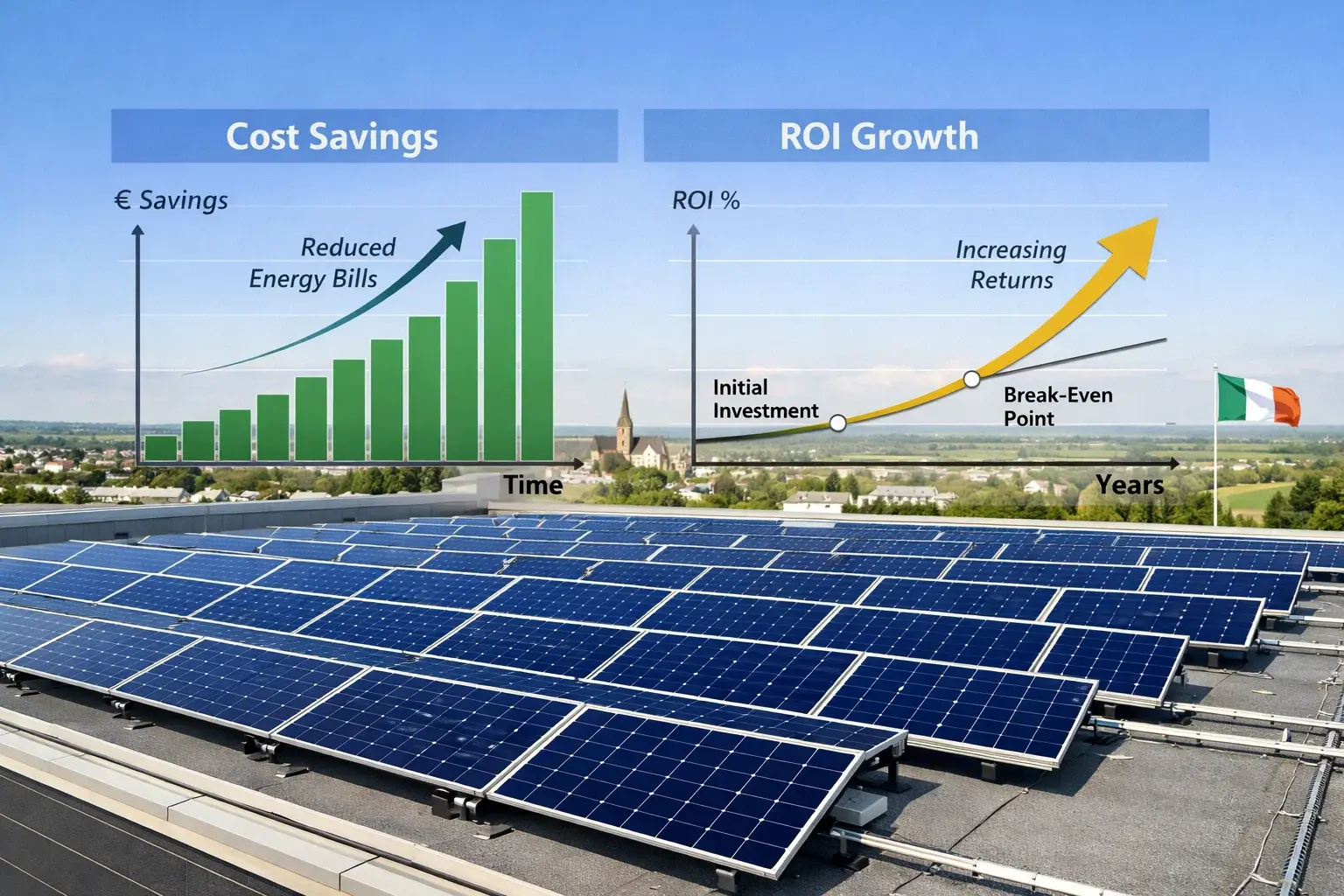
Commercial solar ROI measures the financial return a business receives from investing in solar PV. In practical terms, it looks at how the project reduces grid electricity purchases, how long the system takes to pay back, and how much value it can create over its working life.
ROI should not be judged only by headline system size. A smaller system that closely matches daytime demand can sometimes produce a stronger business case than a larger system that exports too much electricity at a lower value.
Electricity Usage Is the Starting Point
The first step is to review electricity bills and, where available, half-hourly usage data. This shows when the business uses power, how much is used during daylight hours and whether solar generation is likely to be consumed directly on site.
Warehouses, factories, offices, farms, hotels, schools, retail sites and cold storage facilities can all have different usage patterns. The commercial solar design should be based on the actual site, not a generic calculation.
Daytime Demand Has a Major Impact
Solar PV produces electricity during daylight hours. Businesses with steady daytime demand are often better positioned to use more of the electricity generated. This can improve savings because every unit used on site can reduce the amount purchased from the grid.
Sites with lower daytime demand may still benefit from solar, but the system size, export assumptions and possible use of battery storage need to be considered carefully.
Tariffs, Standing Charges and Peak Demand
Energy savings depend on the tariff structure. A business should review unit rates, day and night pricing, demand charges, standing charges and any other network or supplier costs. Solar mainly reduces the energy purchased from the grid, while battery storage may help manage peak demand where the site has suitable load patterns.
This is why a proper ROI estimate should use real bills rather than only system generation forecasts.
System Size and Roof Suitability
Roof space, orientation, shading, structure, fire access, cable routes and electrical capacity all affect the final design. A site with a large roof is not automatically a good solar site if the roof is heavily shaded, in poor condition or difficult to access safely.
For car parks and business parks, solar carports or solar car shades may also be considered where roof space is limited or where EV charging is part of the wider energy plan.
Purchase, Solar PPA or Phased Investment
Direct purchase can suit companies that want ownership of the asset and long-term control. A Solar PPA may suit eligible businesses that prefer lower upfront capital commitment and a managed structure. Some businesses may also install solar first and add battery storage or EV chargers later.
The best route depends on cash flow, payback expectations, accounting preferences, ownership requirements and long-term site plans.
Battery Storage and ROI
Battery storage can improve energy control by storing surplus solar electricity and releasing it later. It can also support peak-demand reduction where the site has suitable usage patterns. However, battery value must be calculated carefully. The right size depends on solar generation, load profile, tariff structure and whether backup capability is required.
Common ROI Mistakes to Avoid
- Using generic payback figures without reviewing actual electricity data.
- Oversizing a system without checking how much power will be used on site.
- Ignoring roof condition, access and future maintenance needs.
- Comparing direct purchase and PPA options without checking contract terms.
- Forgetting future demand from EV charging, expansion or new equipment.
Next Step: Build a Site-Specific ROI Case
Before making a commercial solar decision, your business should review usage data, site layout, roof suitability, tariff structure and finance options together. IRPC can help compare direct purchase, Solar PPA, battery storage and phased installation routes.